Caring for Mixed Age Groups

Karina is not unlike many other family child care providers. She opens her home to care for four other children in addition to her own four year old son. She cares for a young infant and his two year sister full time. She welcomes a three year old on Tuesday and Friday and eight year old Jalika joins the group every afternoon after school.

Unlike child care center teachers, family child care providers often care for children of many ages. Family child care providers may offer services for children as young as six weeks of age and many provide afterschool or summer care for older children as well. Caring for a mixed age group presents a unique set of challenges and benefits for the caregiver.

Challenges

  • The caregiver must take extra safety precautions when there are infants or toddlers in care.
  • It may difficult to find snack items that are appropriate for all age groups.
  • Planning structured activities is difficult when there are children with various ability levels and interests.
  • Daily routines such as nap or meal times may need to be more flexible to accommodate different aged children.
  • Older children may prefer same age peers and resent the younger child in a play group.

Benefits

  • Multi-age groups offer children opportunities to develop and practice social skills.
  • There is a wider range of behavior and performance that is likely to be accepted and tolerated by the adults as well as by the children themselves.
  • There is often less competitive and more cooperative or helpful behaviors.
  • Mixed-age group care is more like a home setting and often a more comfortable and secure setting for young children.
  • Siblings are not separated.
  • By design, mixed-age group care is geared more to the needs of individuals. Children in such groups have greater freedom to develop at their own rate.
  • Older children learn to adapt their language and social skills to relate with younger children, often learning patience, compassion and problem solving skills.
  • Younger children are challenged by older children and often engage in more complex activities then when they play with same age peers.

Tips for caring for mixed-age groups

  1. Provide a wide range of choices. Most caregivers find that most of the day is comprised of unstructured “free play” where they provide a wide range of materials and activities that are appropriate for various children.
  2. Provide some materials that are used specifically for an age group. Not all toys or areas need to be “one size fits all.” It is fine to have some toys that are of specific interest for only one age group.
  3. Consider ages of children when you set up the childcare space. Safety is paramount. Scissors that are used by school-aged children may need to be stored out of the reach of toddlers. Materials that are safe and appropriate for younger children can be arranged in easy to reach bins or containers. You may want to provide smaller sized furniture and step stools for younger children too.
  4. Select toys and materials that are open ended and can be used in many ways. Balls, art materials, blocks can be used by children with various abilities, they will use the material in increasingly complex ways.
  5. Focus on individual or small group activities. Asking a group of children of differing ages to participate together may bore older children or frustrate younger children.
  6. Use the opportunities to promote cooperation and team work. Encourage children to help each other and solve problems together.
  7. Accept the fact you may need to be flexible when scheduling daily routines. Meeting the needs of individual children may mean you need to veer from routine. You may find a need to prepare an extra snack for an afterschool child or set up a quiet area for the youngster who still needs a nap.

Be sure to check out our online class Managing Mixed Age Groups in a Child Care Setting.

Facebooktwitterredditpinterestlinkedinmailby feather
Posted in Administration, Joni | Tagged , , , , , , , , , , , , , | Leave a comment

Penguin Theme for Preschool

by Ellen

I have been collecting penguins ever since I was about 12 years old.  So, when I taught preschool, I made sure to share my love of penguins with a penguin-themed week every winter.  Penguins are a lot more popular now, with all of the penguin movies that have come out in the last several years.  Therefore, a penguin thematic unit is so easy and fun to do.

Here are some of my favorite activities for Penguin Week:

1.  Send a Penguin Home – Introduce a stuffed penguin on Monday Morning.  Tell the children that each night, one child will get to take him home.  Draw a child’s name at random each day.  Send the penguin home with him, along with a journal book.  Have the parent write a paragraph about what the penguin did with the child’s family.  The next morning, during group/circle time, have the child talk about the penguin’s experience at their home.

2.  Paper Plate Penguin

Make these cute paper plate penguins.  Give each child a paper plate and some black and orange construction paper.  Allow them to cut out penguin wings, head, feet and beak.  Provide googly eyes and extra construction paper or supplies for extras, like a bowtie or other decorations.  Allow children to be creative.

3.  How tall are penguins?  On some craft paper, draw the height of several popular species of penguins and include their pictures.  Measure the height of each child to compare.

4.  Make Ice Cream!  This is a fun recipe to get children involved.  They add ingredients to a Ziploc bag and shake it up until it is ice cream.  This is a huge hit with young children.

Ingredients:

  •  1/2 cup milk
  • 1/2 teaspoon vanilla
  • 1 1/2 tablespoons sugar (or to taste)
  • 6 tablespoons salt

Preparation:Put milk, vanilla and sugar into a pint or quart-sized freezer bag. Seal well. Fill a large, gallon-sized freezer bag with ice. Add the salt.Put the smaller bag into the larger bag and seal.Shake and mix until the ice cream thickens, about 10 minutes. You can also let the kids gently throw the bag back and forth to help mix the ice cream. The bag gets very cold, so you might to have children wear gloves when doing this project.


5.  Penguin song: Here’s a cute song to the tune of I’m a Little Teapot…
I’m a little penguin in the snow.
I slide on my tummy to and fro.
I eat the fish from the deep blue sea.
I’m black and white, just look at me.


6.  Penguin Waddle Race – Get medium-size balls and have the children place the ball between their knees and race to a point.

7.  Footprint Penguin art project (if you dare!):

What You Need:

  • White Paper
  • Construction Paper
  • Paint
  • Googly Eyes

What You Do:

Dip the child’s foot in black paint or an ink pad and put on white paper.Add eyes an orange beak and a small white circle for a belly and you have a footprint penguin.

8.  Interactive bulletin board – I created a fishing bulletin board for children to practice number sight words.  For the water, I had children fingerpaint with shades of blue.  I then found a penguin pattern and created fishing poles out of construction paper and yarn.  I put magnets on the end of the yarn.  I had a bowl of construction paper fish nearby…also with magnets).  Children were able to put the correct fish on the matching penguin’s fish pole to match the sight words.  This can be adapted for any type of word match game, math activity, etc.

9.  Frost Covered Penguins  – This is a cool ‘snowy’ effect for any construction paper penguin…using just Epsom Salt and Water.   Make a solution by mixing equal parts boiling water and Epsom and stir well.  You want to make sure the salts dissolve into the water.  Use the solution to paint over your paper.  As it dries, the dissolved salt will crystallize again, creating a frosty, snowy look.

10.  Black and White Day – On Friday of Penguin week, tell all children to wear black and white clothing.  During circle time, brainstorm things that are black and white (penguins, zebras, Oreos, newspapers, panda bears, etc.) – see how many things you can come up with.  Serve all black and white snacks (Oreos, Milk, Marshmallows and chocolate, etc.) – be sure to consider food allergies first.  Practice patterns with mini-marshmallows and chocolate chips

Check out our Polar, Arctic and Winter Animal Theme at Child Care Lounge

Here are more cute penguin crafts


Facebooktwitterredditpinterestlinkedinmailby feather
Posted in Activities, Ellen, Uncategorized | Tagged , , , , , , , , , | Leave a comment

Tips from a TSS (Therapeutic Staff Support) Working with Children on the Autism Spectrum

~Carly

Some of you may be asking what is Therapeutic Staff Support? A TSS provides one- on-one interventions to children of all ages in their home, school, or community setting. The TSS works on specific goals outlined within his or her treatment plan with the child and also with the participation of the family. The goal of the TSS is to assist the family with skills and provide materials for the family to be able to support the interventions independently without the need of a TSS. The goal of a TSS is to work their way out of their job and provide the family with the skills that they need to move on.

You may be asking what can I do as a childcare provider? Childcare providers and TSS form a partnership to work on the individual child’s goals. Many childcare providers have TSS staff coming into their center on a regular basis to work with children that attend their center. The TSS works with the child on his or her treatment plan or goals; it is the childcare provider that helps to support these goals within the childcare setting. As a childcare provider, you would engage with the child and TSS as much as possible; without giving them your full attention (because we all know that is not feasible). The job of a TSS in a childcare setting is to assist the staff in learning new skills to be able to support the child with specific interventions without the need of a TSS.

Autism

Some of the goals that a TSS may work on with the child may be safety goals, communication goals, receptive communication skills and eating goals. I went ahead and listed some examples of what the TSS may work on with the child during a typical session:

  • Safety Goal – maybe the child has difficulty remembering to look both ways before crossing the street, the TSS along with a parent or guardian would work on this skill with the child. The family and TSS may choose a busy shopping plaza to take the child to and practice looking both ways before crossing the street.
  • Communication goal – Maybe the child is non-verbal or has very little verbal skills, the goal of the TSS is to help develop their language skills by using PECS (Picture Exchange Communication Skills).This is where a TSS would have several different pictures of items for the child to be able to communicate without using their verbal skills. This is the beginning step to getting a non-verbal child to begin using some verbal skills.

  • Receptive Communication goal – Maybe the child is having difficulties internalizing what is being asked of them so as a TSS, you work on questions such as “what did you do today?” or “where did you go on vacation?”  Often times the child needs some limited verbal or extended verbal prompting from the TSS and other family to be able to answer these types of questions.
  • Eating Goal – Maybe the child will only eat a peanut butter sandwich for lunch and will not try anything new. The goal of the TSS in this situation is to help assist the parent or guardian in introducing a new food. For example, if the child will only eat peanut butter sandwiches, the family can introduce vegetables with dip to the child. Often time’s children on the spectrum have difficulties with the different textures of foods; they cause gag reflux. If the child takes one or two bites of the new food and likes the food, the parent or guardian has succeeded in adding a new food to what the child will eat.

Working with children on the spectrum is a very rewarding job, although at times it can be very stressful and tiring. I have had the opportunity to work as a TSS (Therapeutic Staff Support) for the past five years. In those five years, I have had five clients all ranging in age from three years old to fourteen years old. All of the children I have worked with have also ranged from non-verbal low functioning to very verbal and high-functioning. The amount of progress that I see in my kids every day is incredible!One of the children that I worked with in the past only spoke three words when I met him. When I was taken off of the case, because the child no longer needed me, he was able to speak full sentences and respond to questions being asked by mom with “yes” or “no” responses.

Please feel free to post your questions, comments on the blog! I would be interested in following up directly with any one that has questions about my position as a TSS.

Facebooktwitterredditpinterestlinkedinmailby feather
Posted in Activities, Carly, Development, Uncategorized | Tagged , , , , , , , , , , , | Leave a comment

Make it a Home Made Christmas

`by Janine

For children, Christmas is a magical time of year. It means Santa Claus, Rudolph the Red Nosed Reindeer and getting toys. However, even young children can understand that it is so much more than simply creating a list of toys and opening them up on Christmas morning.
Create a memory each year that will last from one Christmas to the next.
I decided the year that my daughter was born, that we would celebrate each Christmas with some sort of ornament . . . eventually leading up to the point when she has and tree of her own to decorate that she has a boxful of memories to place on it!
Since she was only a few weeks her first Christmas, we had ornaments made at Things Remembered saying Baby’s 1st Christmas along with her name. We also gave one to each Grandma for their tree as well.

Once she was old enough to help, however, we have included her in the ornament making process each year. She enjoys making something special to give to the people she loves, as well as spotting them on their Christmas trees as well as our own.
Christmas number two we made snowflake ornaments. We purchased small wooden snowflakes and I pained them white. We also bought tubes of glitter glue in a variety of colors. We helped her squeeze the glitter glue onto the ornaments

For our third Christmas, we made Christmas trees. Since my daughter was a year older, she was able to place stickers shaped as jewels onto the trees to decorate them all by herself. We added a bit of silver glitter glue to create the appearance of garland on the tree.

Christmas four was a bit more complicated, since our child’s skill level and attention span had grown. I purchased shatterproof silver balls at a local store. I helped my daughter decoupage them with tissue paper squares in shades of blue for winter. Once the ball was covered with tissue paper, we sprinkled glitter on top to add some sparkle.

This year we have made snow men. We used clear glass balls filled with fake snow. My husband helped my daughter use paint to create a face on the outside of the ball to resemble a snowman . . . eyes and mouth painted black like coal, an orange carrot nose and rosy cheeks. Each face looks completely unique and is a masterpiece. She has even given them names and has started deciding who will receive each of the ornaments she has created.

The best part of this experience, however, was putting up the tree this year and seeing her eyes sparkle with delight as she placed the ornaments she created onto our tree . . . each one a homemade memory created as a family!
We plan to add to our collection with a new hand crafted ornament each year. It is a great way to take some of the spot light off of simply receiving toys and taking the time to make a gift for others and create a lasting memory.

Facebooktwitterredditpinterestlinkedinmailby feather
Posted in Activities, Janine | Tagged , , , , , , , , | Leave a comment

Gingerbread Theme and Activities

Lots of fun crafts and recipes for gingerbread: a food associated with the holiday season.

Gingerbread Crafts

Gingerbread Cinnamon Dough

  • 1 cup ground cinnamon
  • 1 tsp of ginger
  • 1 cup applesauce
  • 1/4 cup white school glue (optional)

Add the cinnamon and ginger to the applesauce. You may add glue for added thickness.
Store unused dough in a bowl with plastic wrap as a cover

Gingerbread Houses
Cover a small milk carton with brown construction paper. Offer a variety of items for decoration.

Gingerbread Recipes

Gingerbread Recipes

Gingerbread Songs and Rhymes

Stir a bowl of gingerbread,
Smooth and spicy brown.
Roll it with a rolling pin,
Up and up and down.
With a cookie cutter,
Make some little men.
Put them in the oven
Till half past ten!

Eat, Eat, Your Gingerbread Boy Tune: Row, Row, Row, Your Boat
Eat, eat, your Gingerbread Boy,
Before he runs away.
Faster, faster, faster please,
Don’t let him get away!

Catch, catch the Gingerbread Boy,
Catch him, yes, today.
Faster, faster, faster still,
For he has run away.

Say bye-bye to the
Gingerbread Boy.
Say good-bye today.
Say so long for he is gone.
The fox ate him today.

More Gingerbread Fun and Activities

Facebooktwitterredditpinterestlinkedinmailby feather
Posted in Activities, Joni, Uncategorized | Tagged , , , , , , , , | Leave a comment

The Importance of a Facebook Presence for Child Care

The Importance of a Facebook Presence for Child Care

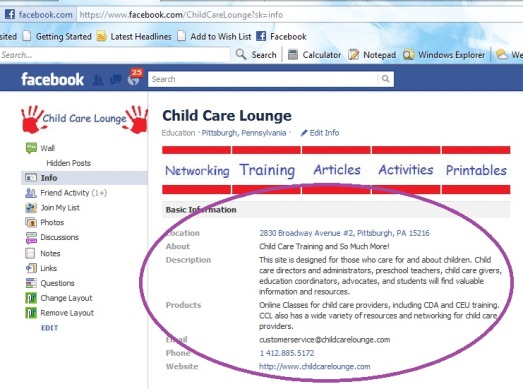
Don’t have a Facebook Page for your Child Care program?  You are missing out!  One of the easiest ways to market your child care program and communicate with current families is right at your fingertips.

No matter how big or small your business is, an internet presence is essential.  People use the internet for so much information, when it is convenient for them.  Many child care programs and family child care centers do not have a website, but an alternative to creating a website is to make a Facebook page for your program.

Currently, there are over 800 million active Facebook users worldwide.  More than 50% of the active users log on to Facebook in any given day.  The average user has 130 friends and is connected to 80 Pages, Groups, and Events. (Source: https://www.facebook.com/press/info.php?statistics)  Where else can you find someone who talks to over 100 people a day?  What better way is there to reach and influence your existing and potential customers?

What should be included your Facebook page:

  • Display all of your contact information.  Your page information tab should include your address, phone number, email, and website, if applicable.  It is important to include all ways for current and potential customers to get in touch with you.
  • The Info section also has places to put your Description, Mission, Awards, and Products. This is a great place to sell your program.  What makes you special?  How do you stand out from other programs?

  • Show pictures of your program.  Your main profile picture should be that of your logo or an overall picture of your center or house.  You can add photo albums to your page also.  Examples of albums could be Art Projects, Room Arrangements, Class Parties, Show N Tell Time, Field Trips, etc.  It is very important to get parents’ permissions to publish their child’s photo to your Facebook page or website.  You can utilize our Permission to Photograph letter (http://www.childcarelounge.com/printform/permission_to_photograph.pdf) or find a Photo Release letter online.
  • Wall Postings.  Once your Facebook page is up and running, you can begin posting on your Wall.  Though there are no rules on how often you should post on Facebook, posting too little can defeat the purpose of a Facebook page, and posting too much can cause your followers to feel bombarded.  It is best to probably keep your postings to 3-7 times a week.  There are many things you can post to your wall:


  • Reminders – Remind parents that tuition is due, that the 4-year-olds are taking a field trip next week, that fundraiser money is due, etc.
  • Announcements – Let parents know that you hired a new teacher, that you passed your latest inspection, that you are extending your hours, etc.
  • Tips – Provide child care/parenting tips and ideas.  Little tidbits and advice can go a long way.  Remember that the average Facebook user has 130 friends.  If they like the advice you post, they have the option to ‘Share’ it on their wall.  This can lead to more exposure to your page.  For example, a current parent may share one of your postings.  One of their friends has young children and was looking for child care.  They may see your post and click on your page, leading them to check out your program.
  • Articles – If you find a good article or news story online, share the link on your wall.

Having an active Facebook page is a simple marketing tool that doesn’t take much time to get up and running.  Just dedicating a few minutes a day to your page can make a world of difference.

Getting Started:

To create a Facebook page for your child care program, you must first be a Facebook user yourself.  If you are not on Facebook, you can create your own personal account at https://www.facebook.com/.  After you have created your own account, you can then create a page.  Facebook has a step-by-step overview of directions on how to create your page.  Directions can be found at https://www.facebook.com/pages/learn.php.

After you first have your page published, it is time to start letting people know you have a Facebook page.  Ask your friends and family to “Like” your page.  Tell your teachers and current parents that your page is now available.  Be sure to include the link to your Facebook page on your website and marketing materials.

Happy Facebooking!

Facebooktwitterredditpinterestlinkedinmailby feather
Posted in Administration, Uncategorized | Tagged , , , , , , , , , , | Leave a comment

All Dressed Up

Why Dress Up Is Important

by Janine

When a child plays dress up, they are doing so much more than putting on a costume. Dress up is a great way to encourage many social and emotional skills that children need to be successful in school, and even later on in life. Here are a few reasons why every preschool classroom should have a bin of dress up clothes.

Dress up encourages creativity. Children can pretend to be whatever they want. They can express their sense of style. It is a way for them to role play scenarios they find interesting. The world becomes as large as the child’s imagination.

Dress up encourages language skills. When children dress up, they often have conversations to act out their play scenarios. They may pretend to be a specific character, such as a waiter taking your food order, or a doctor caring for a sick baby doll. No matter what the set-up, you can bet the child is engaging in some form of conversation.

Dress up encourages positive relationships and cooperation with peers. Children will have to not only share the dress up materials, they will also engage one in another in their play scenarios, often working together to form a role play.

Dress up encourages self-confidence. Children may feel more confident to express their thoughts and ideas while in costume. Often a shy child becomes more expressive while dressed up, because they feel the attention is on what they are wearing and not on them. This allows the child’s personality to shine through.

Dress up encourages children to become comfortable with scary and unfamiliar situations. Role playing about a sick baby doll that needs taken to the hospital may ease the child’s fear of going to the doctor. Children may role play that they are parents leaving their baby doll with a sitter when they go to work, which can help them problem solve separation anxiety issues.

Most importantly, dress up is fun. It is a way for children to escape the real world and let their fantasies and imagination take flight. Make sure to refresh your dress up bin on a regular basis. Keep in mind that just after Halloween is a great time of year to get some amazing deals on costumes and accessories for your classroom

READ MORE!

~How to Setup a Dramatic Play Area

~Ideas for Prop Boxes

Please post a comment and tell us how you use dress up in your program.


Facebooktwitterredditpinterestlinkedinmailby feather
Posted in Activities, Development, Janine | Tagged , , , , , , , , , , | Leave a comment

Do You Have a Child Care Website?

Child Care Lounge is happy to announce our affiliate program!

Our program is free to join, it’s easy to sign-up and requires no technical knowledge

How Does It Work?

When you join our affiliate program, you will be supplied with a range of banners and textual links that you place within your site. When a user clicks on one of your links, they will be brought to our website http://www.childcarelounge.com and their activity will be tracked by our affiliate software. You will earn 10% commission on every class that the visitor enrolls in within the next 90 days!!

If you write a blog or manage an education or parenting website, Child Care Lounge’s web affiliate program offers an exciting way to generate additional revenue for your site.

• We will pay commissions on a monthly basis (issued within 45 days after the end of a month).

Applying to Become a Child Care Lounge Affiliate

To have your blog or website reviewed as a possible affiliate site, please e-mail the following information to joni@childcarelounge.com

• your name,

• your mailing address,

• your website’s URL, and

• a brief description of your web site and its target audience.

After a review of your website and its appropriateness as a possible web affiliate, you will be contacted with instructions regarding how to participate in our affiliate program.


Facebooktwitterredditpinterestlinkedinmailby feather
Posted in Joni, Uncategorized | Tagged | Leave a comment

Witches Don’t Wear Black Shoes: Responding to Children’s Fears

Noah was a four-year-old who had been enrolled in my preschool for a few months. We spent a lot of time together and I had established a very warm rapport with him. Because of this, I was shocked when I entered the classroom one morning and he ran from me screaming, “Stay away from me!” His terror was so intense I had to leave the room until another teacher could calm him down and determine the problem. The problem, it seems, were my new shoes. They were black, and according to Noah, witches wear black shoes!

Fears of witches, ghosts, bogeymen and other imaginary creatures reaches a peak in the preschool years. Whereas as younger children are commonly afraid of everyday things such as dogs or storms; preschoolers tend to develop fears of the imaginary or unreal.

The development of these fears is actually evidence of maturing cognitive development. The child is now more creative and imaginative. And yet, we also know their perspective is still developing. Children in this age range are not very logical in their thinking and in fact have difficulty distinguishing fact from fantasy. In a young child’s mind, objects can take on life-like characteristics. A baby doll really can feel sad and the tree outside can use its branches to intentionally knock on the bedroom window!

It is important both parents and caregivers of young children can understand their fears and respond in an appropriate manner. First and foremost, the adult needs to show respect and acceptance of the child’s fears. These feelings are very real to a child and admonishing or downplaying a child’s concerns do not help a child feel calm or learn to cope with their strong feelings. Forcing a child to confront their fear or pushing them into a fearful situation is often counter-productive. You can serve as both a role model and a guide in helping young children. A slow sympathetic approach is best.

When Noah was so scared that morning, I immediately removed the source of the fear; me. My co-teacher was then reassuring and comforting as she helped him regain control to the point he could tell her what was wrong. She then asked him if he would be frightened if I returned to the room as long as I removed my shoes. He said no, so I returned wearing just socks. I was then able to sit with him and ask if he was still uncomfortable. He made it clear I was only a scary witch if I was wearing the black shoes. Next I asked him if the shoes alone were scary. With gentle encouragement, I took him to the hall to see the shoes where I had left them. I challenged him to talk about how the shoes could transform someone into a witch. “What if a man put them on?” ” What if we painted them red?” I gave him control to find out how this could be less scary for him, and he had the idea he should put the shoes on! “Because,” he said, “I know I am not a witch”. Of course, the shoes brought upon no transformation in him. He then agreed that I was not a witch before the shoes and was able to see they would not change me either. I was then able to put my shoes back on.

I let Noah control the rate of approaching and exploring his fear. At no time did I tell him he was silly or that big boys know better. I will admit that if at anytime he had became anxious or fearful again, I was prepared to back off and may have considered decorating my shoes red for the day. On this day, Noah gained some autonomy and confidence in coping with other fears he may have. He learned that his feelings were important and valued. He learned how to use words to express his emotions. And, of course, he learned not all witches wear black shoes!

Facebooktwitterredditpinterestlinkedinmailby feather
Posted in Development, Joni | Tagged , , , , , , , , , , , , , | Leave a comment

A Shot in the Dark

I originally published this in a child care newsletter where I was working. You may be able to use the content or message to share with parents. Although this happened to me 12 years ago, the message here is as important as ever!

Dear Parents and Families:

While I was on vacation in Florida this past January, I was a witness to a tragedy. I was staying with my mother in an apartment complex that encircled a lovely courtyard. It was the young family that lived directly across from my mother that caught my attention for the first day of my stay. They were my mother’s closest neighbors and it was difficult not to notice the two young children riding a big wheel and pull house along the walk that passed through the cluster of palm tress.

Two days later, it was the blare of sirens that caught my attention. the noise drew us, among other courtyard residents, out into the warm night air. A friend of my mother, who often watched these delightful preschoolers, ran past police and paramedics and in through the propped open door. She emerged with the older child, a blond boy of four, clinging to her and sobbing. I could hear him repeat, “I didn’t want to hurt my sister. I hurt Calli bad.” It took awhile for my mother’s friend to comfort this little boy.

There was no one able to comfort the mother when the police told her that her two-year-old daughter was dead.

The shooting was ruled an accident, but an accident is usually defined as an unavoidable incident. this tragedy was avoidable. The two children were playing unsupervised in the parent’s bedroom. A loaded handgun was lying in the nightstand. Carlton only shot his sister once, but in the chest, and from a distance of only three feet.

I found that my reaction was shared by many of the people gathers in the courtyard that night; a feeling of helplessness. A terrible tragedy had happened and nothing could be done. It was then I realized, although there nothing I could do to change what happened, maybe I could prevent this tragedy from happening to the families and children we care about in our program.

Therefore, I implore you to properly secure all firearms and keep safety a primary concern, preventing avoidable accidents and tragedies like the one I have shared with you here.

  • In 1996, 13 children, age 19 and younger, were killed with guns every day in this country.

  • American children are twelve times more likely to die from gun injuries than are youngsters in all other industrialized nations combined

  •  In 2005, 69 preschoolers were killed by firearms compared to 53 law enforcement officers killed in the line of duty.

  • More 10- to 19-year-olds die from gunshot wounds than from any other cause except motor vehicle accidents.

View more information and statistics on gun safety here

Click here for more information and ways to keep children safe


Facebooktwitterredditpinterestlinkedinmailby feather
Posted in Joni, Safety, Uncategorized | Tagged , , , , , , , | Leave a comment